
Which Crochet Stitch Uses the Least Yarn? 4 Basic Stitches Tested
This post includes affiliate links.
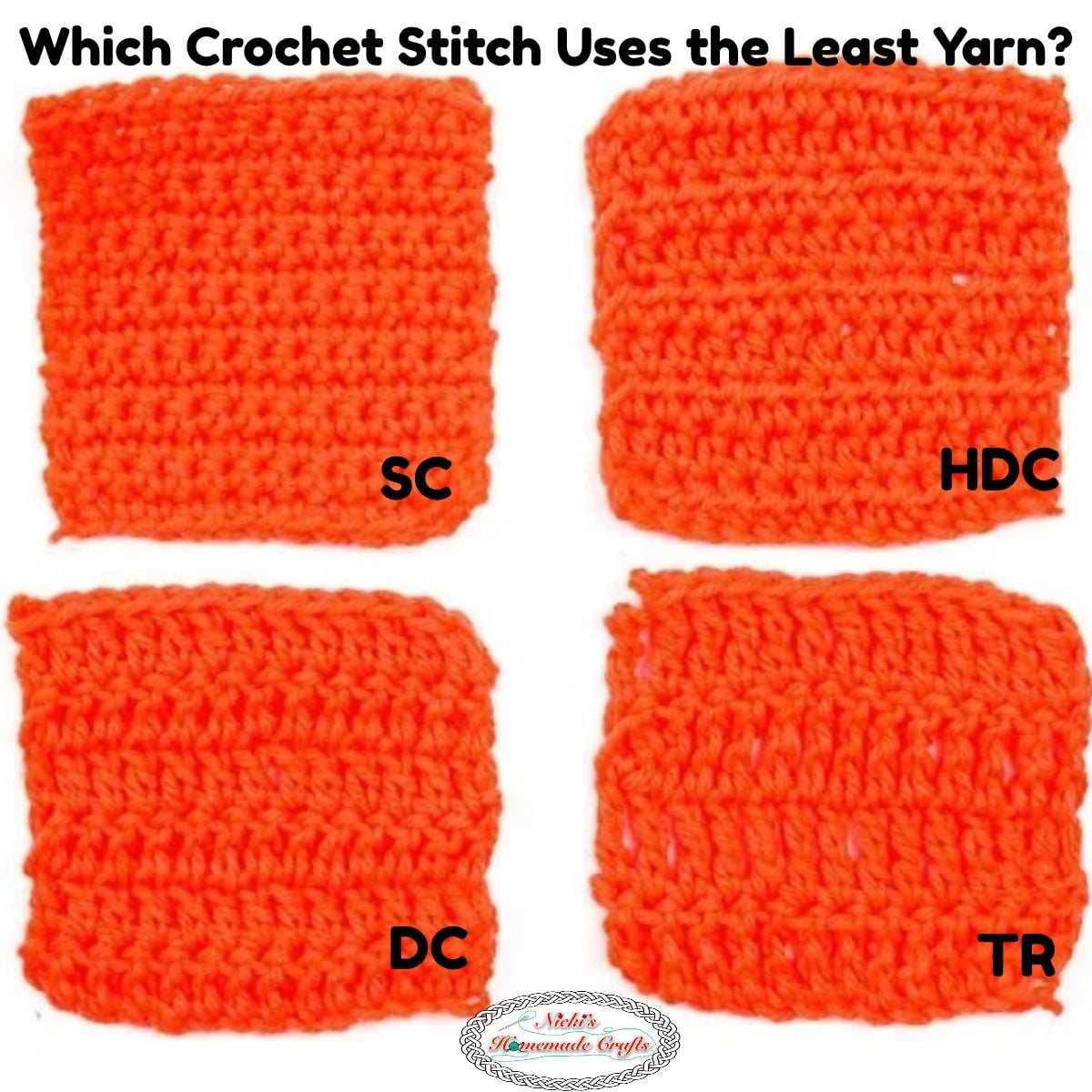
Which crochet stitch uses the least yarn? See my equal-size swatch test comparing single, half double, double, and treble crochet—and the results!
Which crochet stitch uses the least yarn? I tested single crochet, half double crochet, double crochet, and treble crochet—and treble crochet used the least yarn, while single crochet used the most!
For a fair comparison, I made four 4 × 4-inch swatches using the same yarn and hook. Then I unraveled them and compared the yarn lengths. These results apply to my equal-size swatches—not an equal number of stitches. Let me show you what I found so you can plan your next crochet project with less guessing!

I am furious every time I lose at yarn chicken. In case you do not know, yarn chicken is an imaginary game between you and the yarn where you will see which/who will win while finishing a project. If you win, you have yarn left over after your project, and if you ran out of yarn before finishing the project, you lose at yarn chicken.
Every time I lose at yarn chicken, I think about “I wish I had known, before starting a project, which stitch is a yarn eater!”
Well, as I started getting more upset with myself that I did not know the answer to that question, I finally said: “Enough is enough, let’s do the experiment.”
Which Basic Crochet Stitch is a Yarn Eater – Video Reveal
Which Crochet Stitch Uses the Least Yarn? My Results
| Basic stitch—US terms | Relative yarn use in your test |
|---|---|
| Treble crochet | Least |
| Double crochet | Second least |
| Half double crochet | Second most |
| Single crochet | Most |
How to figure out which Basic Crochet Stitch is a Yarn Eater
I came up with a logical experiment that would allow me to figure out which stitch is a yarn eater and which one is not. So, before, I tell you the answer to the so wanted question, let me tell and show you first how I designed the experiment to make it the most successful. You know, like an actual science experiment works (did I tell you that I have a science degree? 😀 ).
Materials:
- worsted weighted yarn (same skein for all swatches)
- same 5.0mm hook
- same scissors
- gauge ruler
- same crocheter to make tension the same
- scale (measure weight of swatches)

What These Yarn Usage Results Mean
I compared four swatches that measured 4 × 4 inches, rather than using the same number of stitches for each one. That matters! A taller stitch covers more height, so comparing equal stitch counts would give you different-sized pieces.
In my test, treble crochet used the least yarn and single crochet used the most. But this was a comparison of four basic stitches using the same yarn and hook, not every crochet stitch out there. Your yarn, hook size, and tension can affect how much yarn your project needs.
Choosing a Stitch When You Have Limited Yarn
Before you switch stitches just to save yarn, think about the fabric you want. Taller stitches can create a more open fabric, while single crochet makes a denser fabric that may suit your project better. Saving yarn is helpful, but you still want to love the finished result!
If you’re worried about running out, make a swatch with your chosen yarn, hook, and stitch first. Then use my Crochet Yarn Amount Calculator to estimate how much yarn you’ll need for your project. A little planning can help you avoid another round of yarn chicken!
Experimental design
- collect all the materials and have a quiet, un-disturbed space and time
- figure out how many stitches per row make 4 inches
- crochet all 4 swatches (sc, hdc, dc, tr) to make a 4 x 4 inch square
- cut off yarn ends of each swatch to make length of yarn used for swatch equal
- weigh swatches and see if one can tell the difference
- if scale did not help, frog the swatches and compare lengths of yarn between swatches
- determine the winner and loser, which basic stitch is a yarn eater
Now, that explained to show what I used and how I designed the experiment to determine the yarn eater of 4 basic crochet stitches, let’s finally get started with the experiment.
I crocheted all 4 swatches by having a beginning chain of 13 plus 1 for single crochet and half double crochet, plus 2 for double crochet and plus 3 for treble crochet. Then I ignored the additional chains after the 13 chains and started crocheted the stitches – one swatch per basic crochet stitch – until I had swatches that were 4 x 4 inches in size. I also did not use turning chains, but rather pulled the last loop a bit longer to start the next row (to prevent added yarn for turning chains and make the swatches comparable).

I, then, tried to weigh all the swatches, but because my scale did not have any decimal digits I was not able to see the difference between the weight of the swatches. So I had to frog them all and add a colored stitch marker to them to determine which frogged pile was for which basic crochet stitch.
As you can see, I determined that pink is for single crochet, red for half double crochet, blue for double crochet and purple for treble crochet.

Next, I held the stitch markers together and started pulling the yarn strands equally to see which strand is the shortest and which ones would come next. That was very exciting, as I had no idea which would be the yearn eater. Finally, I reached the first yarn end, then the next, then the next and finally the last one. I taped them together such that I would not loose the spot where the strands ended.

Finally, I went the other direction again to figure out which one is the shortest. It was the yarn strand for the treble crochet swatch. That one was followed by double crochet, half double crochet and single crochet. Which means the basic crochet stitch ” single crochet” is the yarn eater whereas the treble crochet stitch uses the least amount of yarn. Now, you know which basic stitch to use the next time you have to make a project where you do not know which yarn to use.
You should really watch my video above though. It shows the entire process of me making the swatches and testing the weight and showing you live how I determined the winner. Nothing was edited when it came to showing the results. It was such an exciting process to show it live on camera. I am sure you will love it as much as I do.
Frequently Asked Questions About Crochet Stitch Yarn Usage
Does single crochet use more yarn than double crochet?
In my equal-size swatch experiment, yes! The single crochet swatch used more yarn than the double crochet swatch. Both measured 4 × 4 inches and used the same yarn and hook. This comparison is about covering the same area—not making the same number of stitches.
Is half double crochet a yarn eater?
In my test, half double crochet used less yarn than single crochet but more than double crochet and treble crochet. So it wasn’t the biggest yarn eater of the four! Whether it’s the right choice for your project also depends on the texture and coverage you want.
Does a taller crochet stitch always save yarn?
Not always! Treble crochet used the least yarn in my test, but that doesn’t mean every stitch pattern with taller stitches will use less yarn. Clusters, puff stitches, and other combinations can change yarn usage. Your yarn, hook, and tension matter too, so make a swatch in the actual stitch pattern you plan to use.
How can I estimate yarn for my own crochet project?
Make a swatch using your project’s yarn, hook, and stitch pattern. Weigh it, count its stitches and rows, and check your yarn label for the skein’s weight and yardage. Then enter those details, along with your planned project stitch count, into my Crochet Yarn Amount Calculator. Allow some extra yarn for borders, joining, finishing, and differences in tension.
If you love this yarn eater reveal as much as I do, please use the social media share buttons above or below and share this pattern link with the world and your friends. They and I will thank you! I promise


Very interesting. Thanks for this experiment. I am a relatively new crocheter and I quickly found out I am a tight crocheter. I figured that out when I crocheted an adult size hat pattern and it turned out a good size for a toddler. LOL! I was wondering if I was using more or less yarn by being a tight crocheter. I must be using more yarn by making my stitches smaller. This tight crocheting habit is not all bad – it is an advantage when making amigurumi.
This is a very interesting post! Thank you for going through all of that , for being so meticulous, and for sharing your results.
Amazing! ?
Very good to know! Thanks for your hard work. Also just so you know the little side bar that says Facebook, Pinterest,twitter and google + blocks some of your post and some of the comment block when I am on my iPad or phone. Scrolling doesn’t help at all because it just stays in the way and turning my phone or iPad doesn’t help either. I do not want to upset you or seem like I am complaining, I just thought you would want to know.
That little sidebar only appears on desktop or ipad. I have never seen it on my iphone. Thank you for letting me know. I will look into changing it in the future.
Thank you!
This is a great read!! Thank you so much for “doing the math”!! ☺️